We recently reviewed a one of a kind unique unpowered 2-pair Ethernet extender named the Enable-IT 820 LRE.
The unit is capable of driving Ethernet and dual voice lines over plain old telephone copper (POTS) up to 600ft or 800ft on CAT5 or better.
For those installations that require POE to also be combined you would have to use a Catagory 5 or better (4-pair twisted) for the backbone run in between 820 units. POE requires it’s own 2-pair for voltage so they can co-exist.
More info can be seen at http://www.enableit.com/820.html
Wednesday, October 18, 2006
Extending Ethernet with VDSL
VDSL & VDSL2 (Very high data rate DSL) is an xDSL technology providing data and voice transmission up to a theoretical limit of 52 Mbit/s downstream and 12 Mbit/s upstream over a single twisted pair of wires.
Currently, the standard VDSL uses up to 4 different frequency bands, two for upstream (from the client to the telco) and two for downstream. The standard modulation technique is either QAM (Quadrature amplitude modulation) or DMT (Discrete multitone modulation) which are not compatible, but have similar performance. The current mostly used technology is DMT.
The available bit rates range from about 26 Mbit/s symmetric for a loop of about 1500 m, up to 100 Mbit/s symmetric for a few hundred metres.
These fast speeds mean that VDSL is capable of supporting new high bandwidth applications such as HDTV, as well as telephone services (Voice over IP) and general Internet access, over a single connection.
A new VDSL standard is now available, named VDSL2
Currently, the standard VDSL uses up to 4 different frequency bands, two for upstream (from the client to the telco) and two for downstream. The standard modulation technique is either QAM (Quadrature amplitude modulation) or DMT (Discrete multitone modulation) which are not compatible, but have similar performance. The current mostly used technology is DMT.
The available bit rates range from about 26 Mbit/s symmetric for a loop of about 1500 m, up to 100 Mbit/s symmetric for a few hundred metres.
These fast speeds mean that VDSL is capable of supporting new high bandwidth applications such as HDTV, as well as telephone services (Voice over IP) and general Internet access, over a single connection.
A new VDSL standard is now available, named VDSL2
Extending Ethernet Basics
Originally Posted by hikaru on Austech.com
Iknw this is not a security question but most people here are lcensed to cablers so i thought i might ask here.
Ok i have 2 offices located in the same building.
They both have a 20 pair cable running from the mdf to the idf in each unit. (i,e the share the ame mdf)
I wanto to take 8 pairs and patch it so i get 2 rj45 ports baically coming out of each idf.. connected directly to each other.
Firstly is this legal,
Second i’m not sure on the quality of the 20 pair so would the network rj45 be ok for running a lan over .. 100mb or 1gb?
Lastly if anyone here is in brisbane and it’s legal how much would i expect to pay to get it done?
p0s the reason i’m want to do this is i dont want to stuff around with cabling outside as i would need body corrporate approval and i jut seems too hard__________________OPTUS CABLE + EASYNEWS + DAP = 700KB/s = DEAD QUOTA
1) You can utilize existing copper cabling anywhere as long as you a) Own the cabling b) Cable owner authorizes you to do so, or c) The cabling is inside a building and a or b apply. Telco’s and carries alike are not allowed to own in-building cabling once it is past the terminating (Demarc) Demarcation MPOE (Main point of entry)
You can research the details of this based on the Australian Telecommunications Act of 1997 and revised 2002. * Note you building may perfer a licensed cable installer, however it is not required by law.
2)You have 2 main issues to worry about if you exceed 100 meters between endpoint of the Ethernet segment:
a) Ethernet packet delayb) Ethernet signal attenuation & crosstalk
These can be solved depending on you distance. Typically setting your link speed to a fixed 10MB and Full Duplex will drive an Ethernet signal further. The quality of the copper and noise on the line also is a factor. The delay issue has to do with the guard interval between Ethernet frames and the collision detection mechanism. The Ethernet standard for cabling requires 8 wires.Twisted pair cabling vs straight telephone wiring is a big difference. All Ethernet rated cabling is twisted pair and today usually CAT5e or CAT6 is the preferred topology for new cabling. - Not to be discouraged, any plain telephone wiring, even 1-pair can be used to accomplish this.
Solutions:
The are several low cost solutions on the marketplace today that are certified for use in Australia/New Zealand telecom and can provide a simple plug and play operation.Solutions we recommend looking at are:
The Enable-IT 820 LRE - unpowered Ethernet line Extender (uses 2-pair telephone wire to drive 10MB Ethernet with dual active voice lines up to 182m) http://www.enableit.com/820.html
The Enable-IT 890 LRE - powered Ethernet line Extender (uses 1-pair telephone wire to drive 100MB Ethernet with single active voice line up to 1,830m) http://www.enableit.com/890.html
The Enable-IT equipment is a 1/3 (Third) of the cost of the Patton Electronics and Enable-IT is a local Australian based company with local stock.
Iknw this is not a security question but most people here are lcensed to cablers so i thought i might ask here.
Ok i have 2 offices located in the same building.
They both have a 20 pair cable running from the mdf to the idf in each unit. (i,e the share the ame mdf)
I wanto to take 8 pairs and patch it so i get 2 rj45 ports baically coming out of each idf.. connected directly to each other.
Firstly is this legal,
Second i’m not sure on the quality of the 20 pair so would the network rj45 be ok for running a lan over .. 100mb or 1gb?
Lastly if anyone here is in brisbane and it’s legal how much would i expect to pay to get it done?
p0s the reason i’m want to do this is i dont want to stuff around with cabling outside as i would need body corrporate approval and i jut seems too hard__________________OPTUS CABLE + EASYNEWS + DAP = 700KB/s = DEAD QUOTA
1) You can utilize existing copper cabling anywhere as long as you a) Own the cabling b) Cable owner authorizes you to do so, or c) The cabling is inside a building and a or b apply. Telco’s and carries alike are not allowed to own in-building cabling once it is past the terminating (Demarc) Demarcation MPOE (Main point of entry)
You can research the details of this based on the Australian Telecommunications Act of 1997 and revised 2002. * Note you building may perfer a licensed cable installer, however it is not required by law.
2)You have 2 main issues to worry about if you exceed 100 meters between endpoint of the Ethernet segment:
a) Ethernet packet delayb) Ethernet signal attenuation & crosstalk
These can be solved depending on you distance. Typically setting your link speed to a fixed 10MB and Full Duplex will drive an Ethernet signal further. The quality of the copper and noise on the line also is a factor. The delay issue has to do with the guard interval between Ethernet frames and the collision detection mechanism. The Ethernet standard for cabling requires 8 wires.Twisted pair cabling vs straight telephone wiring is a big difference. All Ethernet rated cabling is twisted pair and today usually CAT5e or CAT6 is the preferred topology for new cabling. - Not to be discouraged, any plain telephone wiring, even 1-pair can be used to accomplish this.
Solutions:
The are several low cost solutions on the marketplace today that are certified for use in Australia/New Zealand telecom and can provide a simple plug and play operation.Solutions we recommend looking at are:
The Enable-IT 820 LRE - unpowered Ethernet line Extender (uses 2-pair telephone wire to drive 10MB Ethernet with dual active voice lines up to 182m) http://www.enableit.com/820.html
The Enable-IT 890 LRE - powered Ethernet line Extender (uses 1-pair telephone wire to drive 100MB Ethernet with single active voice line up to 1,830m) http://www.enableit.com/890.html
The Enable-IT equipment is a 1/3 (Third) of the cost of the Patton Electronics and Enable-IT is a local Australian based company with local stock.
Lightning Protection for Ethernet Extension Equipment
It is unfortunate, but a fact of life, that computers, computer related products and process control equipment found in premises data communications environments can be damaged by high-voltage surges and spikes. Such power surges and spikes are most often caused by lightning strikes. However, there are occasions when the surges and spikes result from any one of a variety of other causes. These causes may include direct contact with power/lightning circuits, static buildup on cables and components, high energy transients coupled into equipment from cables in close proximity, potential differences between grounds to which different equipment’s are connected, mis-wired systems and even human equipment users who have accumulated large static electricity charge build-ups on their clothing. In fact, electrostatic discharges from a person can produce peak Voltages up to 15 kV with currents of tens of Amperes in less than 10 microseconds.
A manufacturing environment is particularly susceptible to such surges because of the presence of motors and other high voltage equipment. The essential point to remember is, the effects of surges due to these other sources are no different than those due to lightning. Hence, protection from one will also protect from the other.
We recommend using off the shelf local electronics or computer store surge and lightning protection power strips. Some common brands are Belkin, APC, Black Box, Tripplite, etc. We also would recommend the use of a lightning rod or air terminal with grounding for areas that are prone to severe lightning strikes.
Lightning rod, or air terminals, have been the front line of defense against lightning. Its basic concept is to provide a preferential terminal for lightning that would have otherwise hit a vulnerable part of the structure. An air terminal only will protect a portion of a building, so most structures will have several lightning terminals. The spacing and position of air terminals has been well understood for many years and the proper configuration and installation of air terminals is detailed in well-known standards, such as NFPA 780 (National Fire Protection Association). Basic direct-effects protection also includes a system of down conductors connecting the air terminals to the grounding system.
The configuration of the grounding system is very important and depends upon soil conditions, building construction and the presence of other underground conductors. Grounding systems can be created with driven ground rods, plates and possibly a counterpoise, which is a buried cable encircling the site. A counterpoise adds greatly to the protection from earth voltage rises that may injure people standing on the ground.
Please keep in mind that nothing is 100% fool proof and the best, and cheapest, way to protect your computer, or any electronic gear is to unplug all power, telephone, cable, (modem), and antenna connections during a lightning and thunderstorm.
A manufacturing environment is particularly susceptible to such surges because of the presence of motors and other high voltage equipment. The essential point to remember is, the effects of surges due to these other sources are no different than those due to lightning. Hence, protection from one will also protect from the other.
We recommend using off the shelf local electronics or computer store surge and lightning protection power strips. Some common brands are Belkin, APC, Black Box, Tripplite, etc. We also would recommend the use of a lightning rod or air terminal with grounding for areas that are prone to severe lightning strikes.
Lightning rod, or air terminals, have been the front line of defense against lightning. Its basic concept is to provide a preferential terminal for lightning that would have otherwise hit a vulnerable part of the structure. An air terminal only will protect a portion of a building, so most structures will have several lightning terminals. The spacing and position of air terminals has been well understood for many years and the proper configuration and installation of air terminals is detailed in well-known standards, such as NFPA 780 (National Fire Protection Association). Basic direct-effects protection also includes a system of down conductors connecting the air terminals to the grounding system.
The configuration of the grounding system is very important and depends upon soil conditions, building construction and the presence of other underground conductors. Grounding systems can be created with driven ground rods, plates and possibly a counterpoise, which is a buried cable encircling the site. A counterpoise adds greatly to the protection from earth voltage rises that may injure people standing on the ground.
Please keep in mind that nothing is 100% fool proof and the best, and cheapest, way to protect your computer, or any electronic gear is to unplug all power, telephone, cable, (modem), and antenna connections during a lightning and thunderstorm.
POE (Power over Ethernet) and the Enable-IT 820
How does one solve the issues of installing wireless AP’s easily? The issues are: Power for the AP, Ethernet Data for the AP, and being able to combine the two over distance (preferred solution).
Most all wireless installers have the same issue of requiring a new power source provisioned for their remote equipment. - This is traditionally solved by having an electrician run separate circuits to the remote area and can be costly if not altogether prohibitive. Several installers have turned to using inexpensive Power over Ethernet (POE) units, since Ethernet cabling still has to be run to the Wireless Access Points anyway.
The issue now becomes POE at distance over cabling. Voltage drops over distance using wires. At 200M, you lose maybe 4 or 6 volts. At 48VDC, that leaves you with 42 volts. If you drop to around 15VDC, your Trango may not come up. You can determine the amount of voltage drop over a distance by finding the resistance of the cable for a specific temperature (given in ohms/1000ft) from the cable manufacturer or electrical wholesaler. If you know the largest amount of current that will flow in the cable, when use the formula: Vdrop = Current X Distance (Ft) X 2 X Ohms per 1000Ft.
As a rule of thumb you will loose 6V per every 100′ - 200′ of wiring, depending on the gauge. Lower power also means more amperage means more heat and perhaps issues with the 24 gauge wires in CAT5. You may need to use 18 gauge wiring. For all intensive purposes anything greater than 400′ use a 48V POE.
Now the second issue of Ethernet distance limits for CAT3 - CAT6 poses a challenge. Ethernet signals can reach a maximum distance of 328′ or 100m safely without degradation (packet collisions, crosstalk, etc) according to the IEEE Specs. In practical reality you can squeeze more distance out typically depending on lots of interference factors.
One solution to this distance issue and support POE at the same time is to use and Enable-IT 820 unpowered Ethernet extender. It was designed to carry Ethernet data over the standard 2-wire pairs (pins 1/2 and 3/6) and POE power over the spare pairs (pins 4/5 and 7/8). So they co-exist.
Another trick is to reduce the Ethernet line speed to 10Mb Full Duplex. This reduces the risk of packet collisions at distance. If you have to, use a low cost 10Mb switch to front end your equipment at the head end. The Enable-IT 820 manual also recommends the same advice. For more details see : http://www.enableit.com/820.html
Most all wireless installers have the same issue of requiring a new power source provisioned for their remote equipment. - This is traditionally solved by having an electrician run separate circuits to the remote area and can be costly if not altogether prohibitive. Several installers have turned to using inexpensive Power over Ethernet (POE) units, since Ethernet cabling still has to be run to the Wireless Access Points anyway.
The issue now becomes POE at distance over cabling. Voltage drops over distance using wires. At 200M, you lose maybe 4 or 6 volts. At 48VDC, that leaves you with 42 volts. If you drop to around 15VDC, your Trango may not come up. You can determine the amount of voltage drop over a distance by finding the resistance of the cable for a specific temperature (given in ohms/1000ft) from the cable manufacturer or electrical wholesaler. If you know the largest amount of current that will flow in the cable, when use the formula: Vdrop = Current X Distance (Ft) X 2 X Ohms per 1000Ft.
As a rule of thumb you will loose 6V per every 100′ - 200′ of wiring, depending on the gauge. Lower power also means more amperage means more heat and perhaps issues with the 24 gauge wires in CAT5. You may need to use 18 gauge wiring. For all intensive purposes anything greater than 400′ use a 48V POE.
Now the second issue of Ethernet distance limits for CAT3 - CAT6 poses a challenge. Ethernet signals can reach a maximum distance of 328′ or 100m safely without degradation (packet collisions, crosstalk, etc) according to the IEEE Specs. In practical reality you can squeeze more distance out typically depending on lots of interference factors.
One solution to this distance issue and support POE at the same time is to use and Enable-IT 820 unpowered Ethernet extender. It was designed to carry Ethernet data over the standard 2-wire pairs (pins 1/2 and 3/6) and POE power over the spare pairs (pins 4/5 and 7/8). So they co-exist.
Another trick is to reduce the Ethernet line speed to 10Mb Full Duplex. This reduces the risk of packet collisions at distance. If you have to, use a low cost 10Mb switch to front end your equipment at the head end. The Enable-IT 820 manual also recommends the same advice. For more details see : http://www.enableit.com/820.html
Enable-IT 8916 multi line Ethernet Extender
On August 8th, Enable-IT announced the availablity of a new powered 1-pair Ethernet extension controller. The 8916 controller has 16 ports (lines) to drive Ethernet and voice signals up to 7,500ft to a end CPE unit. The end CPE unit is a 8910 Ethernet Extneder CPE and provides the end user with a dedicated, swiched 10/100MB link. Awesome! http://www.enableit.com/8916.html
This solution is ideal for Hotel, commercial or residential properties looking to deploy a solid Internet services solution using only 1-pair (2-wires) of existing telephone wiring weather active voice or not.
This has to be one of the most cost effective solutions on the market today at around $200 for each installed line. Other products on the market are at least $250-$300 per installed line and only deliver 1mb-10mb and not the 100mb of the Enable-IT 8916.
This solution is ideal for Hotel, commercial or residential properties looking to deploy a solid Internet services solution using only 1-pair (2-wires) of existing telephone wiring weather active voice or not.
This has to be one of the most cost effective solutions on the market today at around $200 for each installed line. Other products on the market are at least $250-$300 per installed line and only deliver 1mb-10mb and not the 100mb of the Enable-IT 8916.
Hello 3rd Rock from the Sun!
Welcome to Ethernet Extender Experts Google Blog.
This is our initial posting to welcome readers seeking to drive thier Ethernet Further. Look No Further as we have review of current and soon to be available commercial products to exceed your needs. Check back often as we review new products, answer questions and promote Ethernet Broadband Technologies.
This is our initial posting to welcome readers seeking to drive thier Ethernet Further. Look No Further as we have review of current and soon to be available commercial products to exceed your needs. Check back often as we review new products, answer questions and promote Ethernet Broadband Technologies.
Saturday, April 29, 2006
Volcano Experts Leverage PoE Extender Kits To Protect Lives
Volcano Experts Leverage PoE Extender Kits To Protect Lives


USGS HVO IP Camera and Enable-IT PoE Extender enclosure on the rim of Moku‘āweweo caldera near the summit of Mauna Loa.
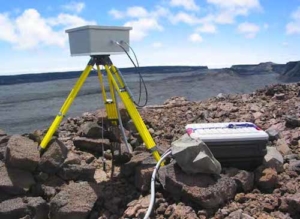
Since 2006 one of our US Government customers – the U.S. Geological Survey at the Hawaiian Volcano Observatory (HVO) has been using our PoE Extender solutions with Remote-Controlled Pan, Tilt, Zoom Cameras at Kīlauea and Mauna Loa, Hawai‘i.
The Kīlauea caldera system has been in an active eruption since 1983. Scientists studying the Kīlauea volcano from the air and the ground have had to contend with hazardous plumes of sulfur dioxide gas that are streaming from the fissure in the ground.
These fissures opened up on the Holuhraun lava field, like a scrape on a person’s skin. The gases may pose a health hazard to populated areas downwind of the eruption, and have been detected as far away as Norway. The scientists are still unsure exactly how the eruption will proceed from here. It could eventually result in flooding or an ash-producing eruption that would disrupt trans-Atlantic air travel and, if it is large enough, exert a cooling influence in the Earth’s climate.
Volcanic hazard sensors focuses include slope stability, landslides, debris flows, droughts, and floods—and their impact on community development, transportation, health, sanitation, and water quality. In addition, PoE and Ethernet extenders are currently in use with the following to help enable remote sensors.
Natural disasters are, by definition, large and disruptive. And for those who are economically, politically, educationally, or technologically disadvantaged, they can be absolutely devastating. Scientists can try to predict eruptions by monitoring the conditions in and around a volcano, usually with an array of sensors.

The sensors and equipment measure the gases for composition, the size and number of earthquakes, ground temperature, bulging of the earth around dangerous area and deep location of the magma beneath the volcano. Sensors can also measure the viscosity of the lava which saves lives by using the viscosity test to find out how fast the lava flow is, the temperature changes the viscosity of lava.

Traditionally sensors were all hand deployed, putting scientists and volcanologists at risk while in use. Today, with advances in solar powered and PoE Extender technology, these sensors can now be deployed long term to cover more area all at the same time. This provides key real time critical information at a remote safe distance to experts that can more effectively interpret the data and better predict disastrous events.
Scientists play a vital role in understanding volcanic behavior and mitigating the risks associated with seismic activity. In today’s technologically advanced era, the use of internet and Ethernet technologies has significantly enhanced their ability to monitor and study our nature and natural disasters. The implementation of Power over Ethernet (PoE) extender kits has revolutionized volcano monitoring by simplifying installations, increasing flexibility, and improving safety.
With the aid of real-time data transmission, volcanologists can closely monitor volcanic activity and make informed decisions that can potentially save lives. The continuous advancements in internet and Ethernet technologies hold promise for further enhancing our understanding of natural disasters and improving our ability to predict eruptions with greater accuracy.
As we continue to explore our fascinating world, it is crucial to remember their immense power and potential for destruction. By leveraging technological innovations and the dedication of scientists, we can strive to protect lives, safeguard communities, and deepen our understanding of these awe-inspiring natural phenomena.
Remember to always heed the advice and warnings of volcanologists and local authorities when dealing with volcanic activity. Through our collective efforts, we can mitigate the risks and ensure the safety of those living in dangerous regions.
Enable-IT has been providing solutions in the remote monitoring and specifically volcanology industry since 2006.
Leveraging technology in PoE Extender and Ethernet Extenders providing simplified solutions.

Highlighting the advantages of incorporating an Ethernet Extender from Enable-IT, our equipment harnesses high-throughput telecom signals across various types of wiring—be it existing or new, including coaxial, telephone wiring, Cat-rated twisted pair, among others. This capability allows for unprecedented distances, setting new standards within this sector. There are Ethernet Extender Solutions available that can extend this distance limit to 9,000 feet or 2,743 meters.
The industry uses are endless – as everyone has a need for extended Ethernet many times in their lifetime and sooner than later the need will arise and we are ready when you are to help select a solution.
Diverse Industry customers include the US, UK and Canadian Military; NASA; Aerospace manufacturers; Nautical Infrastructure (Marinas, Mega Yachts, Cruise Ships,Port facilities, US Nuke sub fleet, etc); Video Surveillance and Security Specialists; Advanced Telecommunications companies; Extreme Mining Operators; Global Construction Enterprises; Commercial Agriculture companies; major Healthcare providers; Live Entertainment, Broadcasting, and News agencies; Extreme Retail/POS organizations; Long-Distance Education Companies; International Hospitality Companies; Elevator manufacturers, digital signage and much more.

Contact any of our team members to learn more or schedule a engineering call if interested in integration off the shelf solutions or highly integrated chipsets for your infrastructure components.
Here is a brief chart of some of our OEM products to consider.


Subscribe to:
Comments (Atom)